
Malta Vision 2050 and Malta’s AI & Robotics Ambition

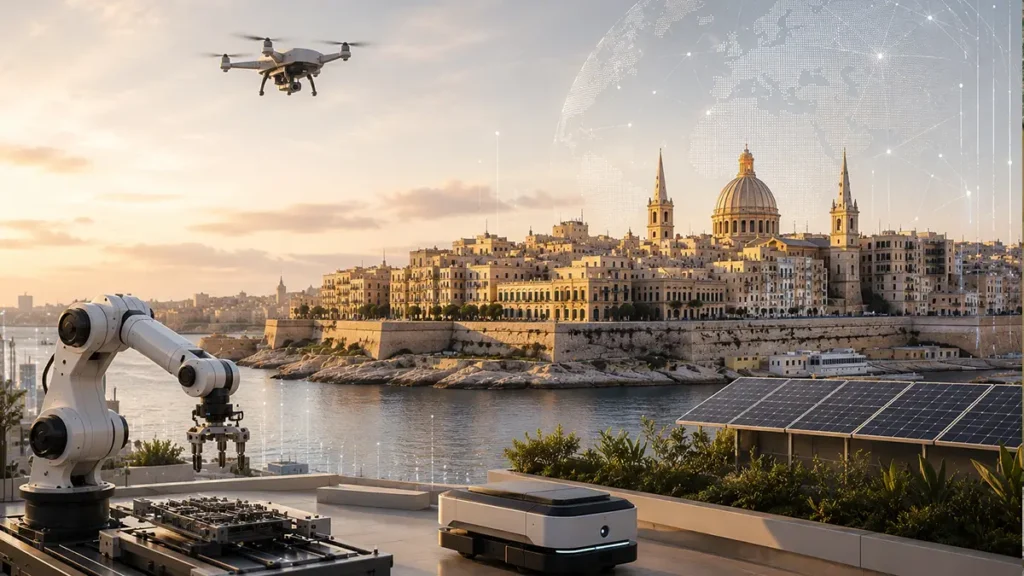
Attracting the Next Generation of Technologists
Legal Takeaways
- Malta Vision 2050 positions AI, robotics, advanced digital industries and innovation-led growth at the centre of Malta’s long-term economic strategy.
- Malta is increasingly positioning itself as a specialist European jurisdiction for high-value technology sectors, STEMM industries and knowledge-driven entrepreneurship.
- The country’s attractiveness increasingly lies in the intersection between innovation policy, European market access, quality of life and institutional agility.
- Robotics, autonomous systems, digital infrastructure and advanced manufacturing are emerging as strategic opportunity sectors for Malta.
- Malta’s residence and citizenship frameworks increasingly operate as strategic mobility infrastructure supporting innovation-led talent and long-term European positioning.
Summary
Malta is increasingly positioning itself as a specialist European jurisdiction for artificial intelligence, robotics, STEMM industries and innovation-led economic growth. Malta Vision 2050 places digital transformation, advanced technologies and knowledge-intensive sectors at the centre of the country’s long-term competitiveness strategy, while simultaneously emphasising quality of life, resilience, sustainability and institutional agility.
For AI founders, robotics engineers, deep-tech entrepreneurs, digital innovators and internationally active family offices, Malta is emerging as a jurisdiction where European market access, innovation infrastructure, regulatory accessibility and long-term strategic positioning converge. The country’s English-speaking ecosystem, EU membership, professional services infrastructure and increasingly innovation-oriented policy framework continue to strengthen Malta’s attractiveness as a European operational and lifestyle base for high-value technology sectors.
Alongside this strategic positioning, Malta’s mobility and citizenship frameworks are also evolving towards a more contribution-oriented model aligned with Malta Vision 2050’s emphasis on innovation, entrepreneurship, research, technology and measurable long-term value creation.
Malta’s Strategic Shift Towards AI and High-Value Growth
Malta Vision 2050 presents a notable shift in the country’s economic positioning. Rather than pursuing volume-driven growth alone, the policy direction increasingly focuses on quality-led, knowledge-driven and innovation-based economic activity.
The Government’s long-term strategy identifies AI-driven industries, financial services, digital infrastructure, aviation, advanced manufacturing and high-value services as central to Malta’s future competitiveness.
The Vision repeatedly frames Malta not as a generalist economy competing on scale, but as a specialist jurisdiction competing on agility, coordination, innovation and strategic niches. Digital industries, AI infrastructure and knowledge-intensive sectors are increasingly treated as strategic pillars of Malta’s future economic model.
This positioning matters because AI and robotics businesses increasingly seek jurisdictions capable of combining:
- EU market access;
- Regulatory credibility;
- Innovation agility;
- International connectivity;
- STEMM talent attraction;
- Competitive operational environments;
- Digital infrastructure; and
- Stable legal frameworks.
Malta’s ambition increasingly attempts to combine all of these features within a compact and internationally connected jurisdiction.
AI, Robotics and European Competitiveness
Malta’s AI and robotics ambitions should not be viewed in isolation. They form part of a broader European race to attract digital talent, robotics expertise, intellectual capital, deep-tech entrepreneurship and globally active innovation businesses.
Within Malta Vision 2050, digital transformation is treated not merely as an economic sector but as a structural enabler across governance, resilience, competitiveness and public administration. The strategy explicitly references the ambition to build a “Digital State by Design” and places “Artificial Intelligence (AI), with Trust at the Core” within Malta’s long-term governance architecture.
This framing is significant.
Across Europe, policymakers increasingly seek to balance innovation with accountability, ethics, cybersecurity and institutional trust. Malta’s future competitiveness in AI and robotics sectors will likely depend less on aggressive deregulation and more on its ability to offer:
- Legal certainty;
- Regulatory responsiveness;
- Cross-border operational flexibility;
- Trusted governance structures;
- Data protection compliance;
- International business accessibility; and
- A high quality of life attractive to senior innovation talent.
For AI entrepreneurs, robotics engineers and deep-tech businesses, strategic positioning decisions increasingly involve a blend of operational, regulatory, research, commercial and family considerations. Malta’s compact size often enables faster institutional access, more direct public-private engagement and greater ecosystem agility than larger jurisdictions.
The country’s future competitiveness may increasingly depend on its ability to support:
- AI research and commercialisation;
- Robotics engineering and automation;
- Autonomous systems;
- Industrial automation;
- Advanced manufacturing;
- Machine intelligence applications;
- Digital health and life sciences;
- Cybersecurity and trusted digital infrastructure; and
- Cross-border technology entrepreneurship.
Malta’s Opportunity in Robotics and Autonomous Systems
One of the most underappreciated aspects of Malta Vision 2050 is the extent to which the strategy supports sectors naturally connected to robotics, automation and autonomous systems.
Malta’s maritime economy, aviation sector, digital infrastructure ambitions and advanced manufacturing strategy all create opportunities for robotics-adjacent innovation ecosystems.
Potential growth areas may increasingly include:
- Maritime robotics and autonomous maritime systems;
- Aviation technologies and drone infrastructure;
- Industrial automation;
- Smart logistics systems;
- AI-enabled manufacturing;
- Robotics-assisted healthcare technologies;
- Autonomous mobility infrastructure;
- Smart city systems; and
- Security and cyber-physical infrastructure.
As European economies increasingly compete for high-value industrial and digital capability, smaller jurisdictions may benefit from their ability to move faster, coordinate policy more efficiently and create specialised ecosystems around targeted innovation sectors.
Malta’s long-term opportunity may therefore lie less in competing broadly across all AI sectors and more in developing recognised strategic niches connected to robotics, automation, maritime systems, aviation technologies and trusted digital infrastructure.
Malta’s Growing STEMM and Innovation Ecosystem
Malta Vision 2050 increasingly frames innovation not merely as a technology objective, but as a national competitiveness strategy.
The Vision identifies advanced manufacturing, digital industries, AI-driven sectors, financial technology, aviation, life sciences and high-value services as core pillars of Malta’s future economic trajectory.
This broader positioning aligns with growing international demand for jurisdictions capable of combining:
- Research capability;
- Commercial agility;
- International connectivity;
- Regulatory certainty;
- Access to European markets;
- Innovation financing;
- Intellectual capital attraction; and
- Long-term strategic stability.
Increasingly, founders, technologists and research-driven businesses seek ecosystems where science, innovation, legal infrastructure and quality of life reinforce one another.
“Malta’s growing STEMM ecosystem is increasingly attracting founders, researchers and technology professionals looking for an agile European jurisdiction where science, innovation, regulation and commercialisation can operate in closer alignment. The jurisdictions that will succeed in the next decade are those capable of translating advanced research and digital capability into trusted long-term economic ecosystems.”
Dr Charlene Mifsud, Partner – STEMM & Innovation, Chetcuti Cauchi Advocates
Why AI Founders and Robotics Innovators Are Looking at Malta
Malta’s attractiveness has historically been linked to language, accessibility, climate, legal certainty and international business orientation. Increasingly, however, strategic positioning decisions are becoming intertwined with innovation geography.
Founders, robotics entrepreneurs, AI engineers and globally active family offices are no longer selecting jurisdictions solely based on tax efficiency. They increasingly evaluate:
- Ecosystem quality;
- Political and regulatory predictability;
- Educational opportunities;
- Access to Europe;
- STEMM infrastructure;
- Digital connectivity;
- Wealth structuring possibilities;
- Long-term family security; and
- Strategic optionality.
Malta’s value proposition increasingly lies in the intersection between European legitimacy and entrepreneurial flexibility.
The country’s English-speaking legal system, EU membership, professional services infrastructure and international orientation continue to appeal to globally active businesses and innovation-focused founders. At the same time, Malta Vision 2050 signals a deliberate move towards attracting higher-value activity rather than purely volume-driven economic expansion.
The Vision explicitly acknowledges the need to transition towards higher productivity, capital deepening and quality employment. It also recognises that future competitiveness will depend on skills, technology and innovation-led growth.
This broader policy environment is likely to favour:
- AI startups;
- Robotics engineering businesses;
- Deep-tech entrepreneurs;
- Digital infrastructure operators;
- Fintech and regtech companies;
- Innovation-focused family offices;
- Research-intensive industries; and
- International operators establishing European footholds.
Strategic Mobility Infrastructure Supporting Innovation Talent
Malta’s mobility frameworks increasingly operate as enabling infrastructure supporting innovation-led international positioning.
For AI entrepreneurs, robotics professionals, technology founders and internationally active investors, mobility decisions increasingly intersect with:
- Business expansion;
- Research collaboration;
- European market access;
- Operational flexibility;
- Talent deployment;
- Family governance planning; and
- Long-term strategic resilience.
Within this broader context, Malta’s residence and citizenship pathways increasingly complement the country’s wider innovation ambitions.
Malta Permanent Residence Programme (MPRP)
The Malta Permanent Residence Programme continues to appeal to entrepreneurs, family offices and internationally active investors seeking long-term European stability and strategic optionality.
Increasingly, the framework forms part of broader succession planning, family governance and European positioning strategies.
Global Residence Programme (GRP)
The Global Residence Programme remains relevant for internationally structured entrepreneurs, consultants and digital operators seeking a reputable European tax residence framework within an EU jurisdiction.
For technology-led businesses and globally active founders, tax residence increasingly forms only one component within broader operational and strategic planning.
Nomad Residence Permit
The Malta Nomad Residence Permit has become increasingly attractive to remote-working founders, AI consultants, software developers, robotics professionals and digital entrepreneurs seeking an agile European base connected to international innovation ecosystems.
Malta Citizenship by Merit
The Malta Citizenship by Merit framework increasingly reflects a broader emphasis on contribution, innovation, entrepreneurship and long-term national alignment.
For technology founders, robotics entrepreneurs, philanthropists and innovation-led investors, the framework increasingly operates within a wider policy environment centred around measurable long-term value creation.
Contributive Belonging and the Future of Citizenship Policy
One of the most significant long-term developments in Malta’s innovation and mobility landscape is the increasing policy emphasis on contributive belonging.
The Malta Citizenship by Merit framework should not be understood through older transactional citizenship narratives. The framework increasingly reflects a broader emphasis on contribution, national alignment and long-term value creation.
This policy positioning reflects wider European trends favouring:
- Innovation-driven contribution;
- Entrepreneurial value creation;
- Philanthropic participation;
- Scientific and cultural impact;
- Long-term integration; and
- Meaningful economic participation.
In practical terms, contributive belonging increasingly centres around factors such as:
- Strategic entrepreneurship;
- Innovation-led economic activity;
- Philanthropic impact;
- Employment generation;
- Knowledge transfer;
- Long-term integration;
- Cultural or scientific contribution; and
- Alignment with Malta’s future-oriented national priorities.
For AI entrepreneurs, robotics innovators, founders, researchers and innovation-focused investors, this creates a more sophisticated framework around long-term strategic participation in Malta.
“Citizenship by merit should be understood as part of Malta’s wider transition from passive attraction to purposeful contribution. In sectors such as AI, robotics and advanced digital industries, the real question is not merely whether an individual can relocate to Malta, but whether their presence, work and capital can help Malta build the knowledge economy envisaged by Vision 2050.”
Dr Jean-Philippe Chetcuti, Managing Partner, Chetcuti Cauchi Advocates
Why Quality of Life Matters to Innovation Talent
An increasingly important aspect of attracting innovation talent is quality of life.
Malta Vision 2050 repeatedly frames quality of life as the country’s “north star” and central benchmark for future policy decisions. The strategy emphasises wellbeing, sustainability, work-life balance, community resilience and long-term liveability.
This is highly relevant to AI founders, robotics entrepreneurs and globally active families.
The post-pandemic environment has accelerated a shift away from purely tax-driven international positioning towards lifestyle-integrated strategic planning. Increasingly, founders and investors seek jurisdictions where:
- Families can settle comfortably;
- Children can access strong international education;
- Travel connectivity is efficient;
- Healthcare systems are reliable;
- Digital infrastructure is robust;
- Regulatory systems remain accessible; and
- Personal wellbeing is compatible with high-performance business activity.
Malta’s size, Mediterranean lifestyle, international community and European positioning continue to make it attractive in this regard.
Strategic Implications for Malta
Malta’s long-term success in the AI, robotics and innovation sectors will likely depend on execution rather than branding alone.
Malta Vision 2050 gives Malta a useful policy compass: attract the kind of talent and investment that raises productivity, deepens capability and improves quality of life. For AI and robotics entrepreneurs, this means Malta should be positioned not only as a place to reside, but as a jurisdiction where high-value contribution can be anchored.”
Dr Jean-Philippe Chetcuti, Managing Partner, Chetcuti Cauchi Advocates
The country’s future competitiveness may increasingly hinge on whether it can:
- Attract high-calibre talent;
- Retain innovation-driven entrepreneurs;
- Build trusted regulatory frameworks;
- Expand advanced education and research capacity;
- Improve infrastructure and liveability;
- Strengthen institutional credibility;
- Scale digital governance capabilities; and
- Sustain a coherent long-term national strategy.
Malta Vision 2050 reflects an awareness of these challenges. The document repeatedly stresses governance coherence, resilience, future-oriented policymaking and strategic alignment.
For AI founders, robotics innovators and technology-driven businesses, Malta increasingly appears to be positioning itself not as a mass-market jurisdiction, but as a specialised European platform for innovation, entrepreneurship and long-term strategic growth.
Malta’s Emerging Role as a European Innovation Platform
Malta’s evolving approach to AI, robotics, innovation and contributive mobility reflects a broader transformation taking place across Europe.
The future of international competitiveness is increasingly less about passive capital attraction and more about strategic participation. Jurisdictions increasingly seek entrepreneurs, researchers, innovators and future citizens who contribute knowledge, innovation capability, cultural capital, philanthropy, investment quality and long-term engagement.
In this evolving landscape, Malta appears to be attempting something more ambitious than a traditional relocation proposition.
It is attempting to position itself as a small but globally connected European innovation jurisdiction where entrepreneurship, technology, robotics, quality of life and long-term belonging converge.
Maltese Innovation, Immigration and Tax Experts Consulted
Dr Jean-Philippe Chetcuti is Managing Partner at Chetcuti Cauchi Advocates and advises international families, entrepreneurs, technologists and family offices on citizenship, strategic mobility and international legal structuring. He has written and spoken extensively on contributive belonging, European citizenship policy and innovation-led mobility frameworks.
Dr Charlene Mifsud leads the firm’s STEMM & Innovation practice, advising technology, life sciences, AI and research-driven businesses on regulatory, commercial and innovation strategy matters connected to Malta’s emerging digital and scientific ecosystem.
RELATED ARTICLES
Malta 15% Tax Programmes Reform and the 2027 Individual Tax Programme

Malta Founder Relocation and Global Asset Structuring: Beyond Immigration Planning

Vantive Malta MedTech Investment

Malta’s Growing Appeal to Americans: Business, Lifestyle and European Access

Why Indians Are Choosing Malta Over Other European Golden Visa Programs
Malta Digital Nomad Visa